
Behaviour and culture
Part of a toolkit for the ethical and effective use of children's information. Select the quick links below to explore the key areas of this page.
Introduction
In this section we explore the system enablers of behaviour and culture from the toolkit for the ethical and effective use of children's information. The framework is organised into three structural layers, system enablers are an essential layer, together with practices and core approaches.
System enablers are the conditions that help improve information use. Behaviour and culture:
- are the ‘soft’ human elements
- include the shared values, norms, attitudes, and practices in and between organisations
- shape how information is seen, valued, and used.
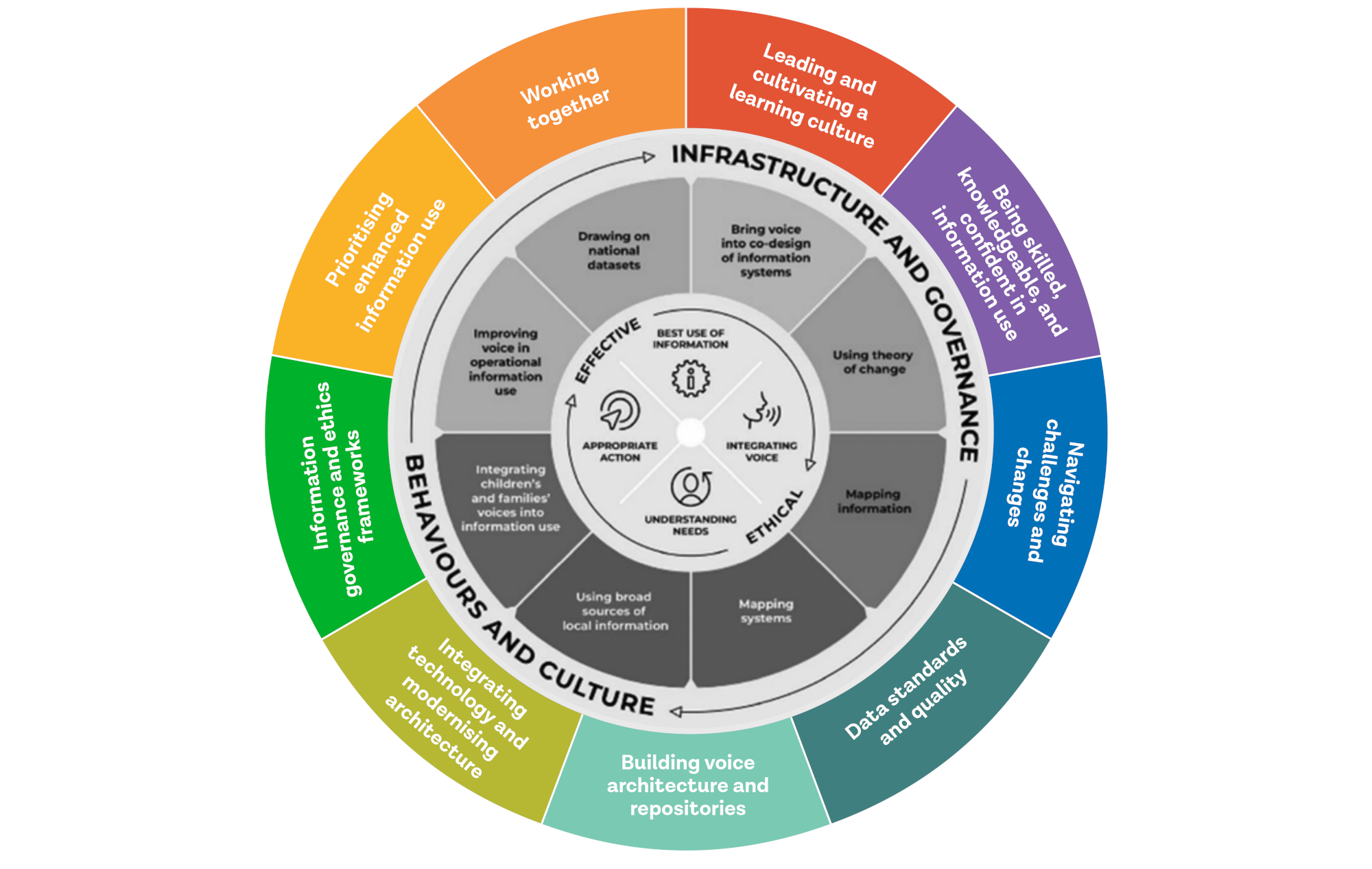
Three structural layers of the framework. System enablers of behaviour and culture are an essential layer, together with practices and core approaches.
A positive information culture encourages transparency, accountability, and ongoing improvement. Leaders value teamwork, foster trust with stakeholders, and adopt a learning mindset. This helps staff at all levels engage confidently with data. Encouraging responsible and ethical information use helps systems maximise the value of information. This helps inform policies, drive innovation, and improve outcomes.
Behaviour and culture can be considered across five domains, alongside each you will find links for practices and enablers. Links to practice examples and tools are also included.

Prioritising enhanced information use
Prioritising enhanced information use needs a clear, sustained commitment from leadership to move beyond compliance data. It is not a single decision or a one-off project, but a consistent approach to leadership, resourcing, and organisational culture. Without active leadership support, information use can be seen as a minor technical task or be sidelined during busy or stressful periods.
When leaders commit to enhanced information use:
-
Information projects become central to daily service delivery. They aren't seen as just technical tasks on the side.
-
Enhancing information use carries equal weight to meeting statutory reporting requirements. This helps keep progress going, even when things get tough.
-
Systems evolve alongside practice. Information tools are updated regularly to meet frontline needs. They offer clear workflows that help practitioners directly, so informal workarounds aren’t needed.
A main job of a transformation lead is to get support from senior leaders to help drive and protect the work. Genuine buy-in is more than a signature on a project plan. It’s about finding a senior sponsor for the work who actively champions the work. This person will defend its priority against other demands. They will clearly explain its importance and stay actively engaged with the process.
To do this in practice:
-
Think about who has the power to say that improving information use is important. Who is responsible for acting on that decision? This could be the Director or Assistant Director of Children's Services, a lead elected member, or a senior equivalent.
-
Link the business case to outcomes they are already responsible for. For example: safeguarding quality, the experience of children in care, or early help.
-
Help them see what is and is not working in the current information landscape and how this can be improved.
-
Be clear about what is being asked. For example, set the priority, protect time and resources, and how they can be involved.
-
Name the risks to the work and how they can be managed. What can the sponsor do to keep things on track?
If the mandate isn't protected, be clear about what can and cannot be done. Also, inform those who need to know the risks. An information improvement project needs senior support to last. Without it, the project won’t withstand serious organisational pressure.
It's important to create a shared understanding of the outcomes the organisation or system aims to achieve together. This matters because improvement without a clear vision often get stuck. Different parts of the system chase their own ideas of what success looks like.
Developing a shared strategic vision requires a collaborative, outcome-focused mindset. This mindset values lived experience alongside performance data. It prioritises real-world family needs over rigid statutory compliance. It recognises that the system needs to move together to achieve shared goals.
In practice, this means:
-
Bringing together people who are impacted by children's information. This includes practitioners, managers, data leads, children, families, and people with lived experience.
-
Agreeing what the problems are. It means focusing on children and families’ needs. It also means finding the barriers and agreeing how to resolve them.
-
Working together to decide what outcomes matter most.
-
Working together to agree priorities and decide how the vision will be achieved.
A shared vision needs structured tools to turn values into action. Be ambitious. ‘Fixing’ one part of the system rarely creates lasting impact. Working together to develop a theory of change can help show the root cause of problems. It will also help set priorities and agree on how to work together to achieve them. Map the information and systems to get a deeper understanding of what is and is not working.
Keep the vision concise and connected to practice. It should be something that a practitioner and a senior manager can both explain in plain language. Review it at the start of each major task. Use it to decide what to prioritise, measure, and change.
Transformation initiatives frequently stall due to insufficient resources. Running workshops and assigning a project manager is rarely enough to deliver sustainable change. Meaningful and sustainable change shifts habits, mindsets, and behaviours. A Project Manager is unlikely to deliver this alone. Without buy-in and support from senior leaders and enough resources, improvements are vulnerable to everyday demands. The wider team may struggle to adopt new practices without enough support.
A shared vision cannot be achieved without protected, dedicated resources. In practice this means:
-
Freeing up capacity and protecting time. Real resourcing goes beyond allocating a budget. Take time to consider how the workforce will participate alongside their other responsibilities. How much time is needed and how will this be protected?
-
Maintaining active leadership participation. Senior leaders should not simply delegate and step back. Consider how to stay visibly involved and drive the change. This might mean championing the vision, clearing barriers, and participating in key discussions. It means consistently modelling an ethical learning culture in daily practice. It means supporting the workforce to test and adopt new habits, mindsets, and behaviours.
-
Ensuring the right expertise is available. Consider what expertise in needed to achieve the shared vision. This might be expertise on specific themes or disciplines such as data, technology, or artificial intelligence (AI). It might also mean people with specific lived experiences.
Working together
Ethical and effective information use relies on working together. When organisations build information systems alone, it can create information siloes. It can also make working together difficult and add to administrative burdens. This section focusses on working together to build relational trust and better understanding. Working together helps spot hidden issues across multi-agency information systems. It helps connect technical systems to the real challenges that frontline workers face.
An effective information system can't be built by just one team or organisation. Stakeholders shape the quality and integrity of children's information in their daily work. To succeed, involving anyone affected by the information system is key.
In practice, this means:
-
Involve key sponsors, like Directors of Children’s Services and Lead Members. They can champion the transformation process. This also helps protect resources.
-
Identifying boundary-spanning professionals who understand practice, technology, and information systems. These people create a common language and close communication gaps. This helps ensure the system design works for both frontline staff and service users.
-
Placing children, parents, and carers at the centre of design is key. This way, systems focus on human needs and better outcomes.
-
Showing how participation adds value. Involvement should feel valuable to the organisation and the participants. Show how involvement can influence how things work and improve outcomes. For professionals, help them see how it benefits their work.
Broad involvement ensures information systems reflect real-world operational realities rather than theoretical assumptions. Setting up this multi-agency network helps bring voice into co-design. It creates the shared ownership needed to transform information into responsive, ethical care.
Working together relies on relational trust that bridges professional silos. Multi-agency organisations work better when they trust each other and use the same professional language. When terminology is misaligned, it can create ambiguity and different priorities. For example, terms can mean different things in Health, Education, Police, and Social Care.
To evaluate and build this trust:
-
Look at how various agencies use key terms like "risk", "threshold", and "engagement". This helps manage uncertainty and improves communication.
-
Build an understanding of each other’s roles and responsibilities, operational constraints, and strengths.
-
Build a space where practitioners hear and value insights from other professionals just as much as their own.
-
Build psychological safety. This helps professionals feel safe to share what they don’t know. It helps reduce defensive and siloed practices.
Dismantling communication barriers builds the relational trust needed to better understand needs. Developing a shared language helps bring diverse voices into co-design. It helps build a shared understanding to map workflows and co-design solutions.
Meaningful co-production relies on setting up the right cultural conditions and leadership mindsets across agencies. It means shifting from shallow engagement to real partnership. Creating spaces for meaningful co-production means establishing safe, accessible, and supportive spaces. Here, families, practitioners, and communities work together to build trust and authority. This way, they can influence how children's information is gathered, stored, and used.
In practice this means:
-
Space: Provide safe, accessible, and non-judgmental environments for stakeholders to gather, reflect, and talk. Spaces might be physical or virtual.
-
Voice: Offer different options for children, families, and staff to express their real experiences and priorities.
-
Audience: Ensure leadership and key decision-makers actively listen and pay close attention. Sit with the discomfort when feedback is difficult to hear.
-
Influence: Show how insights have influenced system design, policies, and practice.
Creating these spaces helps the system move past token consultation. It promotes shared power and delegated responsibility. It creates the conditions to balance loud and quiet voices. It helps quieter voices be heard and have influence. Ideally, these spaces are part of the system, rather than a one-off event. Consider how technology can be used to encourage an ongoing two-way dialogue to improve the system.
Leading and cultivating a learning culture
Leadership behaviours and organisational culture are closely connected. Effective leaders shape the systemic conditions for transformation. They do this by replacing blame and rigid compliance with curiosity, vulnerability, and open inquiry. In stressful, target-driven environments where data is used as a monitoring stick, practitioners often resort to defensive recording or informal workarounds. Cultivating a learning culture transforms information from a tool of surveillance into a vital asset for practice improvement and strategic decision-making.
A learning culture uses a three-step cycle. This cycle helps turn information into positive action.
- Data to Knowledge: The system captures current operations and lived experience. It then analyses what works.
- Knowledge to Performance: Teams from different fields share this insight. They adapt frontline practices and service workflows.
- Performance to Data: Staff share the real-world effects of these practice changes. This creates new, enriched data to continue the cycle.
Traditional top-down leadership approaches can lead to a defensive mindset. Practitioners and families might think their input matters less than statutory data. Without shared authority, quieter voices struggle to make an impact. This can also result in professional tribalism and unclear responsibilities. Distributed leadership shares power. It sees children, families, and frontline professionals as key partners in designing information systems.
To build shared authority in practice:
-
Empower stakeholders, children, and families. Give them a say in project spending and how information systems are set up.
-
Establish clear co-governance frameworks. Be clear on how delegated power interacts with statutory duties. Ensure senior leaders protect and uphold co-designed decisions rather than override them.
-
Get key stakeholders onboard. Find informal leaders. Support those who build trust across teams.
-
Support boundary-spanning champions. Identify and resource informal leaders across practice, data, and partner agencies. They can help build relational trust and bridge communication gaps.
-
Show clear evidence of influence. Keep feedback loops open. This way, users can see how their feedback changed a policy, metric, or service pathway.
Distributing leadership helps create the right conditions. It helps bring voice into co-design and acts on feedback from children and families. Sharing power across organisational boundaries helps partners work together. This way, they share authority and are accountable for outcomes.
Complex social problems worsen in a culture of blame. When senior leaders respond to data errors with punishment, practitioners often become defensive. They might hide mistakes or use unofficial workarounds instead of the formal system. Relational governance focuses on strong relationships and psychological safety. It replaces fear with open curiosity. Unclear data and operational issues turn into insights about how the system works. Leaders use the information to make improvements.
To foster an environment that is psychologically safe:
-
Model leadership vulnerability by being open about uncertainties. Recognise that system complexities exist and finding errors and problem is helpful. It is the first step to finding solutions, not a reason for punishment.
-
Conduct safe-to-fail inquiries. Set up reflective spaces in local forums. These forums look at data anomalies and operational bottlenecks. They also uncover underlying problems without fear of judgment. The aim is to find weak points in the system to improve them.
-
Focus governance on safety, trust, and human dignity. When looking at new technology and information systems, don’t just focus on technical efficiency.
Psychological safety is essential for a learning culture. It builds the trust needed to create a shared vision and work together to achieve it. It is key to navigating challenges and change while staying resilient under pressure.
In many social care settings, supervisors use quantitative data as a compliance tool. This can drive practitioners away from data intelligence and turn complex lives into simple indicators. Practice leaders and supervisors can shift mindsets by using data intelligence as a helpful resource in practice, supervision, and advocacy.
Some ways to achieve this include:
-
Use data in reflective supervision. Create a space to help make sense of data and generate insights. Use caseload charts, timelines, and narratives as shared focus points. This helps explore family stories and practice challenges safely.
-
Practitioners often see patterns emerging in the community. They can help leaders make sense of data and spot community needs and gaps in support.
-
Use data for advocacy. Use local insights and multi-agency dashboards from health, education, and social care to build a picture of need. Data helps build a business case by showing where to allocate resources for the best impact.
-
Prioritise curiosity over compliance. Encourage supervisors and practitioners to explore why data patterns exist. This approach is more valuable than just sticking to process timelines.
Using data in reflective supervision can help shift mindsets. Instead of a compliance stick, data can be seen as a reflective practice or advocacy tool. When practitioners help leaders make sense of data there is a clear value exchange. Building a business case with solid evidence to attract resource further strengthens this process.
Many information system updates fail because they overlook the human side—culture. Upgrading systems without checking cultural readiness can have unintended consequences. It is important to understand how the formal and informal systems work. Informal systems are often used when the formal system doesn’t keep up. These are often called workarounds or shadow systems.
For example, information might be recorded in an offline spreadsheet because it doesn’t have a place in the formal system. Shadow systems might also serve a very good purpose. For example, a team member might be knowledgeable about a subject, so people go to them for support and advice. It’s also important to know where organisational knowledge sits. Sometimes only a few staff members hold key knowledge. This means the organisation's "institutional memories" are at risk, especially if they leave or are unavailable.
A healthy learning culture checks the readiness of the organisation before change is introduced. This helps decide priorities and get a temperature check on how receptive the workforce will be to a transformation programme.
To ensure readiness and collective knowledge stewardship:
- Check cultural readiness. Assess team preparedness and mindsets. Do this before launching new tools to make sure systems address real practice issues.
- Protect and institutionalise collective memory. Prevent loss of organisational memory by documenting key workflows. Crosstrain staff and establish shared knowledge repositories. This way knowledge remains within the organisation when staff move on.
- Understand why shadow systems exist. What purpose are they serving? It may be because the formal system needs to be more intuitive and responsive to change. There may also be behavioural and cultural reasons. Use those insights to improve formal system while safely phasing out informal systems.
- Adopt a custodianship mindset. Make sharing and updating organisational information a standard practice. Value knowledge and enquiry. Value insights from partner agencies as much as your own organisations.
- Create ongoing feedback loops. Set up direct ways for practitioners to report low-value, duplicate, or burdensome tasks. This will help leadership focus on reducing unnecessary administrative work.
Preparing the organisational culture helps create the mindset and behaviours that are important for improving the system. Focus on the reasons that workarounds appear to strengthen the formal system.
Being skilled, knowledgeable, and confident in information use
Supporting the workforce builds the capacity to navigate complex information landscapes. This approach turns children’s information into useful insights, not just a task to manage. Building this human capability relies on three core pillars.
- Skills: This includes the skills and abilities to understand children’s information and share insights.
- Knowledge: This means making use of information in a responsible way. It also involves knowing the laws and systems in place.
- Confidence: This is the self-efficacy mindset. Here, staff feel they can use their skills effectively.
Practitioners sometimes lack confidence when working with children's information. Datasets and visualisations can feel intimidating. Also, rich family stories and insights can easily get lost in lengthy case records. Beliefs about data can change behaviours. When staff see data collection as a tick-box task, it changes how they act. They may concentrate on filling out the form correctly instead of gaining insights from the information. Improving information literacy helps staff understand, analyse, and use data. This leads to better real-world results.
To support information literacy in practice:
-
Develop the capacity of the workforce to read and interact with data.
-
Prioritise family needs over tick-box exercises.
-
Encourage staff to be professionally curious. Practitioners think critically about information, not just enter data.
-
Use information-driven advocacy to blend voice and data when securing resources for families.
-
Create a safe space for understanding data. This way, the workforce can admit if they don’t understand a report or data visualisation.
-
Prioritise peer learning and coaching over training to build skills and confidence.
-
Provide teams with self-service analytics tools, like Microsoft Power BI, so they can create their own data insights.
-
Consider how artificial intelligence (AI) can help generate insights from data and support learning.
Sharing information is vital for child safeguarding. However, serious case reviews show that information is often not shared for a range of reasons. For example, legal myths, professional anxieties about data protection, and human error. Professionals have a duty to share information, but a lack of confidence can stand in the way. Building confidence means moving from just telling people to share information. Instead, create the conditions for timely and proportionate information sharing. These conditions span behaviours and culture and infrastructure and governance.
Behaviours and culture that build information sharing confidence
-
Make sure professionals know why sharing information is important. They should understand how it helps protect children and improve their outcomes.
-
Shift the story from fearing data rules to highlighting the duty to share information for children's safety.
-
Encourage professionals to be curious and reward them when they ask tough questions. This helps build psychological safety.
-
Build relationship-based multi-agency networks through joint training and informal networking. Work on bottlenecks where information gets stuck or doesn’t flow well.
-
Encourage a professional culture that values information quality over the status of the person sharing it.
When looking at how information flows, it is helpful to map information and systems to see what is and in not working well. It may also be helpful to adopt technology to help professionals share information. Learn more, explore integrating technology and modernising architecture.
Social care projects often stall because technology does not align with practice reality. Digital literacy and competency act as the bridge between technical design and daily practice. Literacy provides the foundation, while competency applies those skills to real-world situations. If practitioners struggle to use technology, a new system is unlikely to help.
Foundational digital literacy skills:
-
Use software and hardware confidently to manage records.
-
Apply critical thinking skills to analyse digital information and spot bias.
-
Learn basic data protection and to recognise cyber threats.
-
Maintain appropriate professional etiquette across messaging and email platforms.
Advanced digital competency applications:
-
Solve real-world social work problems by using digital tools like a single digital view to share information.
-
Use technology to cut down on social work overheads. This includes making information retrieval easier and reducing communication and process burdens.
-
Shape how information is gathered and recorded so systems reflect real family experiences.
-
Balance technology use with essential face-to-face conversations.
-
Protect family privacy while using digital platforms.
AI is evolving at a rapid pace. It offers both opportunities and risks, along with ethical questions about our use of information. AI algorithms can affect outcomes for children and families, both positively and negatively. AI can influence how we record information and make decisions. AI can influence information that can follow a child into adulthood and shape lifelong opportunities. Developing role-based AI competencies provides essential guardrails for children's services.
Key practices for responsible AI use:
-
Understand what AI can and can’t do and choose the right tool for the job.
-
Use human-AI teaming to mitigate risks. Be clear on the strengths and weaknesses of humans and AI. Work as a team to mitigate the weaknesses of the other.
-
Be informed about how algorithms work. Think critically about AI content instead of just accepting it.
-
Have clear governance about how to fact-check and review AI outputs. Be sure to keep the context and family story intact.
-
Use critical thinking to ensure professional judgement takes precedence over algorithmic outputs.
-
Pause for ethical reflection before adopting new automated tools. Build this cultural habit.
-
Treat AI adoption as a change programme, not a standard software rollout.
-
Always prioritise privacy by never including personally identifiable information in open AI models.
-
Think about how to monitor and evaluate AI's impact on the results we want. Watch for unintended outcomes across the AI life cycle.
-
Be balanced about what is being lost and gained by working with AI.
Navigating challenges and changes
Explore how organisational culture responds to pressure and also examine how these reactions impact daily information use. Handling challenges and changes well shows a system is resilient. A resilient system maintains its learning culture and ethical standards, even during a crisis. This resilience acts like a shock absorber. It stops information systems from becoming defensive and blaming others when under pressure. It helps prevent the system from reverting to old ways when challenges arise.
Success depends on psychological safety and critical thinking. This helps the workforce avoid process-blindness and defensive behaviour. Punitive responses to mistakes from senior leaders can stifle learning and create a cycle of fear.
Critical incidents or system failures can lead to blame, which creates a culture of fear. Under this pressure, the workforce can become uncertain, defensive, or risk-averse. Staff might feel uncertain about what they should record or share. This can lead them to revert to old habits or become stuck.
Keeping psychological safety during tough times shows a commitment to a no-blame approach, even as risks increase. It allows an open and honest approach to what is not working. This helps to solve problems as they arise. It also prevents information systems from becoming tools of surveillance or defensive bureaucracy. It also recognises that transformation can be uncomfortable.
Helpful practices to build psychological safety through deeper understanding:
-
See mistakes as chances to learn. Instead of blaming or punishing, view them as valuable lessons. They are the first step to solving a problem.
-
Embracing uncertainty and vulnerability during tough times builds trust and resilience.
-
Understand how people experience change, transition, and transformation.
-
Recognise that transition is an uncomfortable experience. People let go of old ways to adopt new mindsets, behaviours, and habits.
-
Accept that transformation is difficult to achieve and unexpected results can happen.
-
Empower the workforce to think critically and look past surface events to reflect on the root cause of problems.
This approach maintains structural stability and professional trust while improving information systems. It avoids a blame culture and instead encourages deeper understanding of transformation.
System enablers are often invisible until they break. Likewise, teams may take a learning culture for granted until a crisis hits. Leaders may miss important cultural information if they don't assess cultural readiness.
This enabler encourages proactive, scenario-based methods. Leaders can evaluate how the organisation reacts to stress and crises to build resilience. It is helpful to understand how the workforce responds to stress, resource shifts, and system shocks without reverting to old habits.
Helpful practices to build adaptive capacity include:
-
Be proactive. Monitor cultural risks, gaps in relational trust, and potential failure points before a crisis happens.
-
Run a cultural health check to understand how the culture reacts under pressure.
-
Use scenario-based learning to understand how teams respond to different situations.
-
Foster the psychological safety needed for teams to maintain curious, reflective practice under stress.
-
Look at how information flows between agencies to understand relational trust, system design, and ways of working.
-
Energy mapping helps check if a team has the emotional bandwidth and mental focus needed to handle change well.
-
Understand the workforce’s attitude to case recording. Is it seen as a meaningful exercise or an administrative burden?
Understanding culture helps leaders address vulnerabilities early. This proactive investment creates a flexible, responsive system. It helps create a safe space for practitioners to use their skills and judgement without fear of reprimand, even when stressed.
Practice examples and tools
Practice examples
-
Making better use of children’s information, data and voice.
-
How we can work with children, young people and families to make better use of data.
-
Practical approaches for families first and beyond: Webinar resources.
-
Rochdale: Developing a theory of change for the early years.
-
How we can work with children, young people and families to make better use of data.
-
Discussing the use of generative AI in children’s social care case recording.
-
Understanding the emerging use of artificial intelligence in social work education and practice in England: Research report (2026).
-
Artificial intelligence (AI) in case recording - National workload action group supplementary report.
External resources
A toolkit for the ethical and effective use of children's information
Digital resources explore definitions, tools and examples for practitioners and data leads to strengthen children's information use.