
Leading change, transition and transformation
| Part of a toolkit for the ethical and effective use of children's information - practical tools.
Organisations do not transform; people do. While change is an external event—such as a new software rollout, a restructured department, or an altered operational process—transition is the internal psychological process people experience to adapt to that new reality. Transformation is the ultimate, long-term outcome. It’s the collective evolution in culture, mindset, and capability that happens when transitions are successfully navigated across an organisation.
Understanding how people experience transition is the foundation of effective change management. Without addressing the psychological journey, even the most meticulously planned organisational change risks friction, disengagement, and failure.
The discomfort of transition
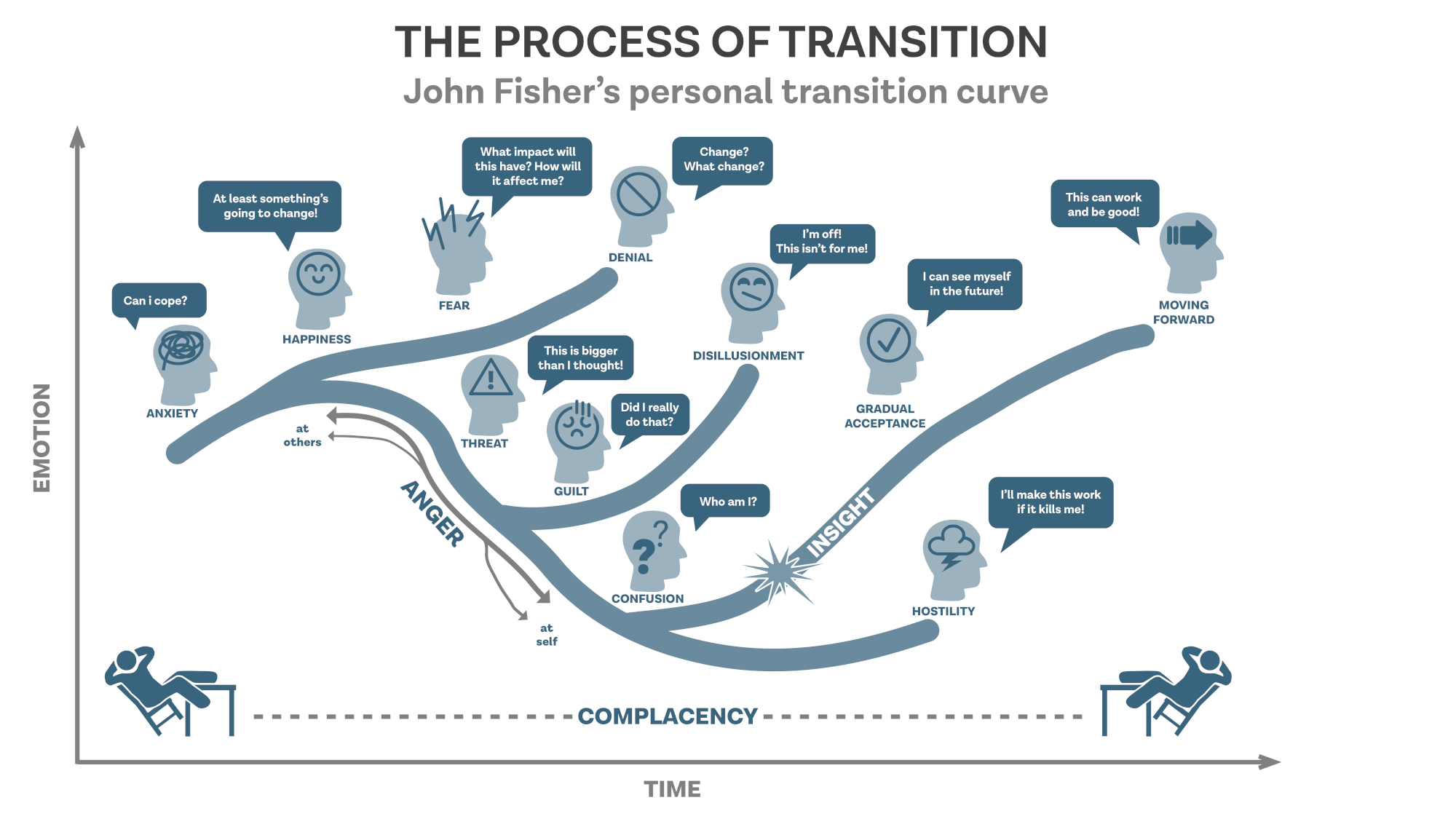
Transition is an uncomfortable experience. Psychologist John Fisher’s Personal Transition Curve illustrates the complex, non-linear emotional journey people go through when facing organisational change. People rarely move through change in a straight line. Instead, they navigate a range of reactions from initial anticipation to deep uncertainty before reaching commitment.
The initial response: anxiety, happiness, and fear
When a change is first announced, initial reactions vary. It will depend on the person's perception of impact:
- Anxiety: A person immediately questions their capability, asking, 'Can I cope with what is being asked of me?'
- Happiness: If the change resolves a long-standing pain point, some feel immediate relief: 'At last, something is going to change!'
- Fear: As the implications sink in, anxiety turns to fear regarding personal impact: 'How will this affect my role, status, or security?'
The mid-transition dip: threat, guilt, denial, and confusion
As the reality of the change takes hold, people enter the most vulnerable phase of transition. Without targeted support, people risk getting stuck or opting out entirely:
- Threat and guilt: Some people perceive the change as larger than expected ('This is bigger than I thought!') and may feel guilt or regret over past methods ('Did I really do that wrong for so long?').
- Denial: To protect themselves from discomfort, some pretend the change isn't happening ('Change? What change?').
- Disillusionment: When old ways no longer work and new ways are unfamiliar, some people may disengage or leave ('I'm off! This isn't for me!').
- Anger and hostility: Frustration can turn outward toward leadership or inward toward self-doubt. In extreme cases, hostility arises as a desperate attempt to resist the new reality ('I'll make this work if it kills me!').
- Confusion: The core identity phase where old habits are stripped away, leaving individuals asking, 'Who am I in this new environment?'
This is the most vulnerable point for people and the project. Leaders may misinterpret what is happening and pivot, pause, or end the project. At this point, leaders should consider what people need to move them on to the next stage.
What do people need in the mid-transition dip
During the mid-transition dip people are grappling with a range of emotions. They are also experiencing a temporary crisis of competence, identity, and security. Moving people through this vulnerable low point requires targeted support designed to address each specific emotional driver.
Countering Denial
The core focus is overcoming non-acceptance and grounding reality. Leadership strategies include:
- Grounded communication: Deliver direct, transparent facts showing that the change is non-negotiable and the status quo is no longer viable.
- Identify what stays the same: Highlight organisational 'anchors' (core values, key relationships, foundational skills) to prevent individuals from feeling entirely displaced.
Mitigating Threat
The core focus is addressing fear of personal competencies and anxiety. Leadership strategies include:
- Safe testing environments: Provide low-stakes practice spaces (simulations, peer trials, sandbox tools) where people can experiment and make mistakes without performance penalties.
- Empathetic listening: Offer dedicated, confidential 1-on-1s or small peer groups to voice anxieties, validating feelings to reduce defensiveness.
Responding to guilt
The core focus is to reframe past ways of working and release old loyalties. Leadership strategies include:
- Honour past contributions: Explicitly validate past achievements, framing the transition as an evolution driven by new external conditions rather than past failure.
- Explicit permission to let go: Formally release staff from legacy obligations, reporting lines, and outdated procedures to eliminate divided loyalties.
Resolving confusion
The core focus is to reframe identity and clarify new roles. Leadership strategies include:
- Granular role definition: Answer the core identity question ('Who am I in this new model?') by providing concrete clarity on new daily routines, performance standards, and decision-making authority.
- Targeted coaching: Pair individuals with mentors or peer coaches to help them translate their expertise into the new operational context.
Moving towards insight
Insight cannot be forced through mandates. It must be experienced individually. To trigger the breakthrough moment where a person realises 'This can work for me', leadership strategies include:
- Micro-wins: Break the transition into small, achievable milestones to build self-efficacy through quick, successful outcomes. This helps create ‘proof’ that it can be done.
- Peer-led discovery: Facilitate horizontal learning where early adopters share how they navigated the dip. People are more likely to achieve insight by observing trusted peers than by listening to top-down presentations.
- Reframing questions: Use self-discovery coaching questions (e.g., 'Which part of your current workload would you most like this new approach to simplify?').
Once a person achieves insight, their focus shifts from protecting their past identity to exploring their future role, unlocking gradual acceptance and forward momentum.
Integration
Once insight is achieved, acceptance gradually begins to happen. This allows people to move forward and adopt new ways of working. Leadership strategies include:
- Gradual Acceptance: The person begins to visualise their role in the new model: 'I can see myself in this future'.
- Moving Forward: The change is internalised and integrated into daily routines: 'This can work, and it is beneficial!'
Key principles for change leaders
To guide teams through Fisher's transition curve effectively, change leaders should apply three core principles:
- Distinguish change from transition: Manage the project mechanics (schedules, tools, milestones), but lead the human transition (emotions, training, support).
- Create psychological safety: Acknowledge that feelings of fear, confusion, and anger are natural responses to change. Providing safe spaces for open dialogue prevents anxiety from turning into outright hostility or denial.
- Tailor support to individual stages: A single broadcast message will not reach everyone equally. Someone in Denial needs clear, unambiguous facts; someone in Confusion needs coaching and role clarity; someone reaching Insight needs reinforcement and recognition.
By treating transition as a human process rather than a transactional event, leaders can turn resistance into commitment and achieve lasting organisational transformation.
A toolkit for the ethical and effective use of children's information
Digital resources explore definitions, tools and examples for practitioners and data leads to strengthen children's information use.