
Infrastructure and governance
Part of a toolkit for the ethical and effective use of children's information. Select the quick links below to explore the key areas of this page.
Introduction
In this section, we look at the system enablers of infrastructure and governance in the toolkit for ethical and effective use of children's information. The framework is organised into three structural layers, system enablers are an essential layer, together with practices and core approaches.
System enablers are the conditions that help improve information use. Infrastructure and governance are the ‘hard scaffolding', they form the backbone of the system:
- Infrastructure includes technical architecture, platforms, and tools used to collect, store, share, and analyse information.
- Governance covers the rules, agreements, and ethical frameworks that define accountability and ensure information is kept safe, high-quality, and compliant.
This helps ensure strong leadership at every level and manage risk effectively. Infrastructure and governance work hand in hand to create clear, fair, and responsible information use.
Infrastructure and governance can be considered across four domains, alongside each you will find links for practices and enablers. Links to practice examples and tools are also included.
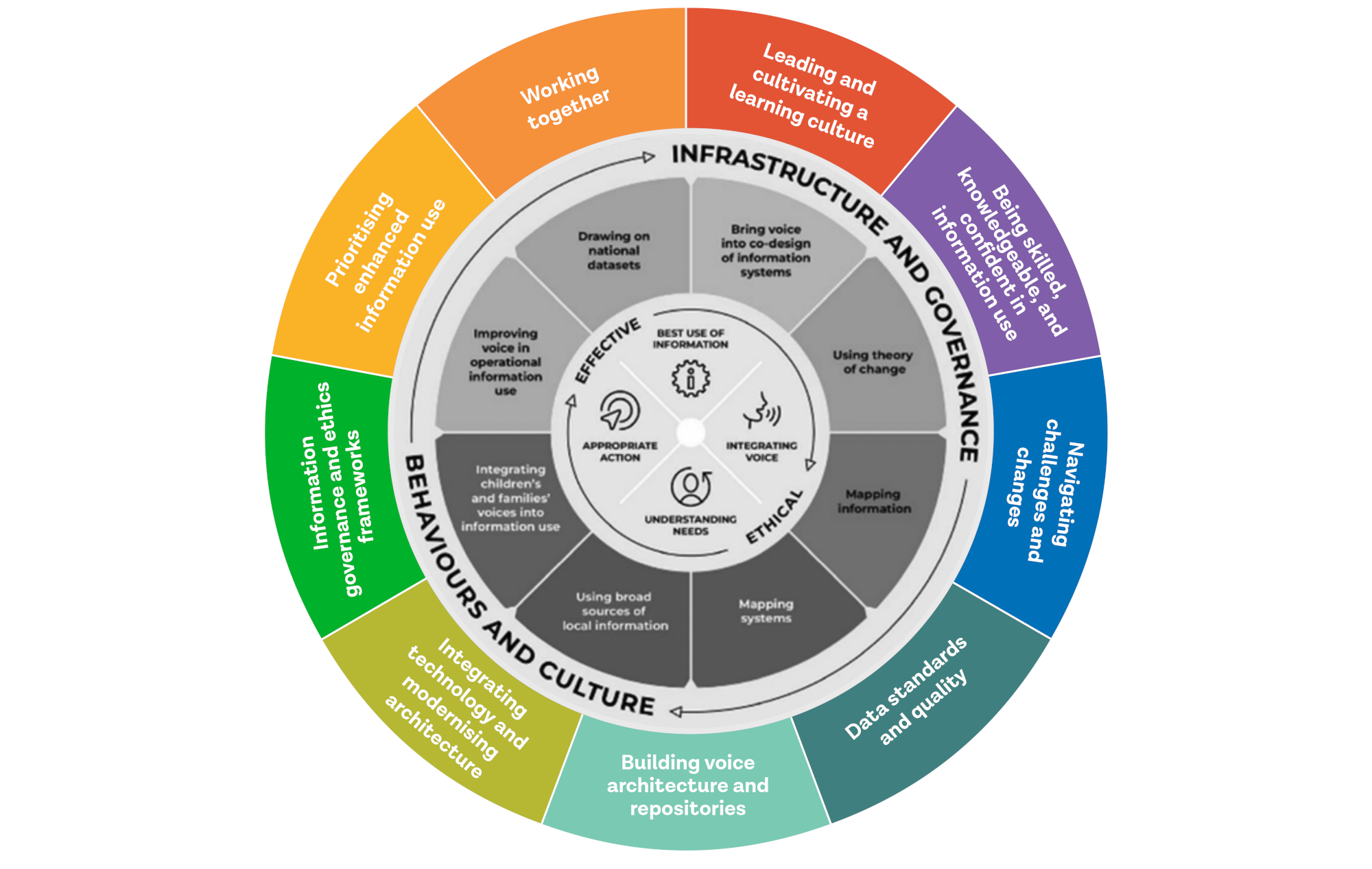
Three structural layers of the framework. System enablers of infrastructure and governance are an essential layer, together with practices and core approaches.

Data standards and quality
Focus on transforming fragmented data into a high-quality professional information asset. Data quality and standards create a foundation for more advanced information use. Standardising the data environment keeps important information about the child’s safety and wellbeing clear. It helps organisations share and match data so earlier help can be provided. Reliable data standards help align organisations and become a common language. Emerging technologies, like artificial intelligence (AI), can access higher quality data to create insights.
Children's information is stored in different organisations and is often siloed. Organisation use various software, formats, and data definitions. This poor interoperability creates a fragmented picture and acts as barrier to identifying need and risk early.
Traditional datasets often reduce complex information to simple measures. This process reduces detailed family histories to simple, compliance-focused indicators for statutory returns. Simplifying information in this way leads to a loss of voice, nuance, and context.
Building a solid data foundation keeps information clear and usable across different agencies. To help build strong foundations.
- Assign data stewards and owners in each department and agency. This ensures someone is clearly responsible for data definitions and standards.
- Make an effort to understand data produced by another agency. Be clear on definitions and how meaning is applied to data.
- Standardise data definitions and map data across partner agencies. This will help ensure alignment locally and nationally. More consistent data tells a more consistent story.
- Know the source and history of the data. In multi-agency settings, practitioners need to know when information was recorded and how current or reliable the source is.
- Use various data cleansing strategies to check for duplicates and redundancies. Validate and clean incoming data before it reaches analytical tools.
- Align data access controls with Information Sharing Agreements (ISAs) to ensure sensitive information is shared securely and seen only by authorised roles.
- Store and share both qualitative and quantitative data. This helps ensure the voices in data are diverse.
- Provide continuous training and support to bridge data literacy gaps. Practitioners don't need to be data scientists, but they do need to know how to read data and ask the right questions.
- Consider how the quality of data might influence decisions and assumptions about where resources should be targeted.
- Consider how the quality of data might influence AI insights. AI can amplify existing biases and produce poor outputs if data is poor.
Strong data foundations transform fragmented records into reliable practice tools that enhance professional judgment. Strong data foundations allow modern capabilities like single digital views and AI intelligence layers. For example, artificial intelligence can serve as an intelligence layer to help with searching, summarising, and spotting patterns more easily.
Practitioners are often overwhelmed with expectations around data collection and recording. New data fields are often added without removing outdated or redundant recording requirements. This increasing burden can cause cognitive overload and distracts from other purposeful work. It also makes it difficult for practitioners to distinguish between important safety insights and process-driven noise.
Unchecked data expansion leads to practitioner disengagement and defensive recording. Over time, this will affect the quality of data. Being purposeful about what data is collected and recorded helps reduce duplicates and redundancies. It also streamlines workflows and helps practitioners feel more engaged.
In practice, being more purposeful means:
- Setting up a formal system to regularly review the purpose, relevance, and necessity of existing data fields.
- Applying Caldicott Principles to ensure information gathering is necessary, proportionate, and legally justified.
- Retiring any obsolete or low-value data fields when a new one is added, or even before that. Adopt a 'one-in, one-out' policy.
- Setting up clear feedback channels. This way, frontline practitioners can report outdated, duplicate, tedious, or low-value data tasks.
- Review local dashboards to make sure they focus on what matters to families, not just compliance metrics.
Simplifying the data environment keeps the focus on the child's real journey. Removing low-value metrics changes the purpose of the system. It becomes less of a surveillance tool and more of a framework that supports practice and outcomes. When the administrative burden lessens, practitioners engage more positively with platforms. This can directly improve data quality at the source.
Building voice architecture and repositories
Local authorities gather large volumes of information from a variety of sources including children and families. This information holds vital insights about children’s needs and lived experience. Voice is gathered and stored in a range of ways, including:
-
Recorded in unstructured information in case notes.
-
Gathered in a focus group as part of a project.
-
Feedback from multi-agency professionals.
-
Insights shared by a practitioner in supervision.
-
Compliments and complaints from people who access services and the community.
These diverse voices are often stored in siloes instead of being a meaningful part of the data ecosystem. Often, insights are gathered and not revisited.
Setting up systems to capture, store, and analyse voice helps ensure it has the same value as traditional metrics. Creating data schemas, secure storage, and helpful software tools for voice makes this information easier to access and use. It means voice can have a greater impact on practice and strategy. It also helps keep the authentic voice of children, families and social workers central in the information system.
Designing systems that streamlines how voice is gathered and stored helps put voice at the centre of system design. Instead of voice being stored in siloes, centralised repositories make key messages and insights easier to access. Sentiment analysis and insights mean individual privacy remains protected. Voice architecture helps give lived experience equal status with data.
In practice this could include:
- Reducing the barriers to having a say. Create both physical spaces and user-friendly digital platforms to capture voice. They should work together to make it easy to provide feedback. Not everyone is comfortable with technology. Also, not everyone is comfortable with groups.
- Analyse the information already available. There is already rich voice information available.
- Consider how technology can make it easier for children, families, and practitioners to provide feedback. AI is an assistive technology that can bridge learning and language gaps. This can help quieter and marginalised voices be heard.
- Embed feedback tools into daily workflow software to encourage feedback from practitioners and other professionals. This helps move beyond basic compliance tracking and becomes a tool for co-production.
- Create a centralised voice repository with insights from sentiment analysis. Avoid siloes and asking the same questions again.
- Build platforms that provides two-way feedback. Tell people how their feedback made a difference. Spotlight other feedback and ask for responses to spot consensus and friction.
- Systems can also be designed to collect creative ideas and suggestions. Get people involved in how to improve things.
Thoughtful design means local authorities don’t have to rely on isolated consultation. Create a culture where an ongoing dialogue is the norm. Use technology to support this. Well-designed information architecture can synthesise insights from multiple touchpoints. For example, digital case records, message uploads, apps, and forums. Purpose built voice architecture gives it structure and value. It means local authorities can have an ongoing two-way dialogue about how to improve service delivery. This creates a learning culture. It transforms vital information from a static siloes into nearly real-time operational knowledge. This creates a responsiveness system that continuously improves and self-corrects through daily interactions.
Social care digital platforms often can seem confusing or too bureaucratic for families and busy professionals. People with learning, language, or literacy difficulties may struggle with text-heavy websites. They may miss out on important information and support as a result. They may also miss out on providing feedback.
AI can act as an assistive technology to help bridge learning, language and literacy gaps:
- Simplify complex information. User-friendly AI assistants can explain legal rules, turn technical terms into simple language. It can help users with administrative tasks at their own speed.
- Bridge language barriers. Secure translation tools help people who don't speak English. They can access important information and share feedback in their own language.
- Bridge literacy and learning gaps. Voice-to-text and AI summarisation tools transcribe spoken feedback. This means children and families could contribute more to their own assessments, case records, and care planning.
Voice is expressed in many ways. AI offers an opportunity for less heard voices to be amplified.
- Support non-verbal communication. Advanced AI tools can understand context, predict text, and turn symbols or eye movements into natural-sounding speech. This helps non-verbal people and those with severe speech impairments share their views and take part.
- Improve access for people with physical and sensory disabilities. Some AI tools can turn what we see into sound. These tools help people with visual, hearing, or physical impairments to independently navigate digital services and review case details.
To build public trust in assistive digital tools, ethical guardrails and good governance is needed. Using AI as an assistive technology could result in less human contact, which might feel isolating. AI can also get thing wrong. It’s important to have human oversight to monitor the AI and how people are using it. It shouldn’t replace human relationships.
Integrating technology and modernising architecture
Focuses on creating a seamless digital ecosystem where technology helps understand a child’s circumstances and reduces administrative burden. There are technological solutions to chronic safeguarding issues, such as information sharing and managing large volumes of information. Upgrading legacy information systems to be more interoperable and intuitive has a range of benefits. It can result in more timely and consistent information sharing and reduce retrieval burden.
When systems don’t work properly or don’t adapt to change, workarounds emerge. This carries risks. There are technological solutions that can help share information and automate routine processes. Integrating technology and modernising architecture can support practice and help manage workload.
Case management systems are often designed for data reporting rather than practitioner workflows. When formal systems become rigid or old, professionals often build informal systems. These are often called shadow systems or workarounds. For example, they might use local Excel spreadsheets to track information. These workarounds lead to double handling of data. Information is recorded in informal logs, then re-typed into the formal database or report. Information in spreadsheets often stays isolated. This leads to fragmented records and lost information. It also means that data standards and definitions can vary wildly.
To eliminate shadow systems and increase data usage, local authorities might find these tips useful:
- Identify the workarounds and shadow systems where information is stored.
- Understand why the informal systems exist. The formal system may need to be updated, but there may be behavioural and cultural issues.
- Consider how the formal system can be redesigned. How does it align with the daily workflow of practitioners? How does it align with the child and family’s circumstances and journey?
- Use secure mobile technology to update records on the go.
- Explore safe ways for children and families to add to their digital records. Use AI as an assistive technology to bridge communication gaps and build independence.
- Set up easy ways for practitioners to report software usability issues as they happen.
- Regularly review system design to make sure the information system keeps up with practice.
Making the formal system easier to use makes it more valuable than offline solutions. Removing double data entry lightens the admin load. This gives practitioners more time for more purposeful work, like family support. A well-designed information system helps make better use of information. It shifts the system from being an administrative burden to a helpful tool for practice. A good system creates the trust that reduces the need for workarounds.
Children’s Information often lives in siloes across multiple organisations. This can make it hard to see the full picture. Traditional databases usually need exact character-for-character data matching to connect records. This often fails because names and addresses may not match across health, education, police, and social care.
A lack of interoperability means vital information about a child’s needs or safety may be missed. Information sharing is usually a time-consuming manual task. Errors and inconsistencies can happen. A Single Digital View (SDV) offers a technological solution by automating data flows across multi-agency systems.
To build a SDV, local authorities can take several practical steps:
- Establish strong data foundations by improving data standards and quality.
- Align information-sharing arrangements with Caldicott Principles to maintain strict ethical standards.
- Be clear on the legal basis for proportionate information sharing via a SDV.
- Use a Single Unique Identifier to connect records across agencies more easily.
- Use AI-enabled probabilistic (fuzzy) matching to connect files that contain minor data-entry inconsistencies.
- Design the platform to share voice and data. This ensures the child and families voice travels with their data to add context.
- Use artificial intelligence as an intelligence layer. It helps to search, summarise, and find hidden patterns of risk and need in large datasets.
A SDV cuts down the time spent on finding and sharing information. It also improves consistency and timeliness. It can reduce the need for families to repeat their histories. The platform helps professionals to work together more effectively.
A SDV helps automate some information sharing. However, it can't replace direct conversations or personal connections in social work. It should also balance privacy with utility. A SDV should have clear role-based access, so partners only see information required for their specific role. Consider:
- What should and should not be shared via a SDV.
- How qualitative information could be shared alongside quantitative data.
- How the child and family's voice can be represented alongside professional voices.
Share enough through a SDV to spark a conversation among professionals. Sharing too much can lead professionals to over-depend on automation. This may cause them to skip essential safeguarding discussions.
AI is being adopted at a fast pace in social care. There are many benefits to using AI in case recording, administration, and information management. Organisations are also adopting more autonomous systems, like AI assistants, AI agents and predictive models.
There are a range of ways that AI can help manage information:
- Public-facing AI chatbots, assistants, and agents can act as assistive technology to bridge communication gaps and build independence. This supports children and families and shifts some workload from practitioners.
- AI can help prepare case records and correspondence. It can also help with administrative tasks and information and knowledge management.
- AI can act as also act as an assistive technology for neurodiverse social workers. AI is a reasonable adjustment that helps with case recording and task management.
- AI can enable people who access services to contribute to case recording, planning, and self-service in new ways.
- AI can add an intelligence layer to case management systems (CMS), Single Digital View, or other databases. It has enhanced search and analytical capabilities that go far beyond a human’s capacity.
- AI can be used to automate or semi-automate processes and workflows, so information flows better.
- AI predictive models can help to find patterns of risk and need early on. It can also help forecast service demand.
- AI can enable adaptive learning pathways for continued professional development.
AI offers many opportunities to enhance social work information systems. It also brings risks and ethical challenges. Concerns include:
- Data protection.
- Privacy.
- Surveillance.
- Algorithmic bias.
- Dependence on AI.
- Deskilling of workers.
Good governance, AI literacy skills, and human-AI teaming can help reduce many of these risks and ethical challenges.
Human-AI teaming can help reduce risks and ethical challenges associated with using AI in social work. Simply combining humans and AI does not guarantee better results. Poorly designed interactions can lead to worse performance than either working alone. Proper Human-AI teaming (complementarity) creates a strong partnership. It recognises the strengths and weaknesses of humans and AI. This balance helps them achieve more than either could on their own.
How this looks in practice:
- Design workflows that work with the strengths of humans and AI.
- Avoid too much or too little trust in AI.
- Create interfaces that display AI confidence levels in the output. They should also state reasoning and any uncertainties.
- Train teams to understand what AI can and can’t do. This will help manage their expectations.
- Train teams to think critically. This way, they won’t just accept automated recommendations without question.
- Be clear on who is best at performing specific tasks and assign them accordingly. Write a job description for your AI tool based on its capabilities and limitations.
- Deploy AI for well-defined, highly structured tasks where algorithms excel. Keep decisions and judgement for humans.
- Treat AI literacy as a core social work skill. Consider what AI literacy and role-based competencies practitioners, practice supervisors, practice leaders, and people with quality assurance responsibilities need.
Aligning these technical and human gears increases operational accuracy and speed. This balance keeps professional intuition central to practice. The Complementarity Framework sets out where humans and AI excel across three cognitive processes:
- Reasoning,
- memory,
- attention, and
- the cross-cutting theme of meta-coordination and governance.
Information governance and ethics frameworks
Information governance and ethics frameworks set moral boundaries. They create permission structures for multi-agency working. They balance individual privacy rights with the shared duty to protect children. This clear governance reduces anxiety and boosts professional confidence. Clear ethical guidelines make sure that information systems help support people rather than act as surveillance tools. This approach helps maintain public trust across services.
Information governance and ethical data stewardship mean balancing two important things. The legal need to share and manage personal information with the duty to protect children.
Information governance focuses on formal compliance, legal duties, and regulatory rules to ensure data is stored, shared, and accessed safely, consistently, and legally. For example, GDPR compliance, Caldicott Principles, Data Protection Impact Assessments (DPIAs), and Information Sharing Agreements (ISAs).
Ethical data stewardship is about values-led decision-making and human judgment. For example, balancing the legal duty to protect children with the responsibility to respect family privacy.
Information governance and ethical data stewardship provide the practical rules and tools to:
- Ensure information sharing is necessary and proportionate.
- Improve timeliness and efficiency of information sharing.
- Mitigate algorithmic bias and prevent intrusive surveillance
- Keep human judgment and public trust at the heart of the work.
The Children's Wellbeing and Schools Act 2016 and the Working together to safeguard children 2026 - statutory guidance set a clear duty to share information. These provide a legal foundation and clear ethical guidelines on how to share information safely. There is growing interest in automated information sharing through single digital views. Emerging technologies, like artificial intelligence (AI), are also being used to search and analyse shared information. These technologies are unregulated and add a layer of complexity to information governance and ethical stewardship. Risks and ethical challenges linked with these technologies could erode public trust in services.
Using technology to share and manage information has many benefits. It also has risks and ethical challenges. This makes governance and ethical data stewardship crucial:
- Align local data-sharing rules with legal duties. This will help shift away from unclear consent models.
- Translate national guidelines into clear local operating procedures across all multi-agency partner platforms.
- Create standard, legally binding Information Sharing Agreements. This will reduce duplicate efforts and protect legal boundaries.
- Embed data minimisation principles in the technical architecture. This way, tools will only access the records needed for the task.
- Use formal templates for sharing information. Base them on the Caldicott Principles. Follow the legal rules for sharing and the vital interest’s test.
- Update Data Protection Impact Assessments (DPIAs) regularly. Treat them as living documents that change as platforms and AI models evolve.
- Carry out regular bias checks and assurance tests on AI tools. This helps spot problems like data drift or analytical errors.
- Clarify roles and responsibilities across agencies. Be clear on how high information governance and data stewardship standards will be maintained.
- Be transparent. Share details on how technology uses and interacts with personal information. Keeping people informed is essential for maintaining public trust.
- Consider creating dedicated oversight committee to review data practices and address emerging privacy and ethical concerns.
Build and maintain standards through infrastructure and governance and also consider behavioural and cultural elements. For example, ensure the workforce is skilled, knowledgeable, and confident in information use. This includes information sharing confidence and developing digital and AI literacy and competencies to mitigate risks. Also consider how culture will influence standards.
Integrating advanced information systems and AI into children’s services needs clear ethical boundaries. This helps ensure safety, fairness, and accountability. An ethics framework moves beyond passive legal compliance to put values into action. There are a range of ethical frameworks available. Together, these frameworks help balance technical efficiency with privacy, equity, and the public good.
Designing information systems with ethical frameworks helps local authorities. It allows them to balance efficiency, privacy, and the public good.
How this looks in practice:
- Embed the core principles of The Framework for ethical & effective information use. The Framework includes core approaches, information use practices, and system enablers.
- Check the impact of data linkage and algorithmic tools using ethical assessment frameworks. Do this both before and after deployment to monitor impact over time.
- Use strict ethical guidelines for buying technology, including AI. This ensures AI applications are transparent, explainable, and open to ongoing monitoring and evaluation.
- Ensure technologies are reviewed by people with suitable expertise. Understand how the tool handles and stores information, especially if vendors are in other countries where GDPR can’t be enforced.
- Explain clearly to the public how information is gathered, stored, and used. Also, show if, how and why AI interacts with this information. Have clear guidance about informed consent.
- Be careful when using AI tools if its reasoning is unclear. Also, ensure end-users have a way to challenge AI decisions or outputs.
- Monitor the full lifecycle of digital tools and AI applications by assessing their real-world effects. Focus performance measures on what matters most to children and families, not just organisational priorities.
Ethics should guide which technology is developed or purchased, and from whom. This helps build public trust and uphold social work standards. Ethical design keeps the voices and rights of vulnerable children and families central as digital infrastructure grows.
Practice examples and tools
Practice examples
-
Discussing the use of generative AI in children’s social care case recording.
-
Artificial intelligence (AI) in case recording - National workload action group supplementary report.
Internal resources
External resources
-
Guidance for local authorities on building a single digital view: Transform Family View.
-
Inclusive digital healthcare: a framework for NHS action on digital inclusion.
-
The AI Readiness Assurance Framework and Readiness Checklist.
-
Guidance for public sector organisations on how to use data and data-driven technologies responsibly: Data and AI Ethics Framework.
-
Information Sharing Duty (September 2026) - Statutory guidance for safeguarding organisations and their practitioners (PDF).

A toolkit for the ethical and effective use of children's information
Digital resources explore definitions, tools and examples for practitioners and data leads to strengthen children's information use.