
Earlier this year, Research in Practice conducted a small number of focus groups to hear from professionals in a range of roles about what supports them to use evidence in their practice.
We wanted to hear what facilitates their use of Research in Practice resources and the impact that this has in their work. We spoke with 13 professionals from three local authority Partners working with children and families and four local authority Partners working with adults.
Conversations took place in groups defined by role and level of experience: early career and newly qualified professionals, experienced professional, team managers, and workforce development and practice educators. Invitations were focused on speaking with professionals who were more frequent users of evidence and Research in Practice resources specifically.
Key messages about what supports engagement with research and evidence, and specifically Research in Practice resources were:
- Knowing resources are peer-reviewed and evidence-informed gave practitioners confidence in using resources.
- Short, focused learning formats are accessible when caseloads and work pressures are high.
- Team culture and leadership behaviours strongly shape whether evidence is used routinely.
- Early career and newly qualified practitioners have a key role in sharing resources and current research within teams. Equally, practice educators have an important role in guiding students in their learning, creating foundations for ongoing practice. They have an excellent knowledge of current research and evidence that is valued in developing broader evidence-informed practice.
Identifying challenges and barriers
Participants shared that the main challenge to using research and evidence was time pressures. Confidence was also identified as a barrier.
We heard professionals describe differences between settings where learning and evidence-informed practice is embedded and progression encouraged, and those where evidence-informed practice is less of a focus or expectation is focused only at early career stages. We also heard that access to research and evidence can be more difficult once professionals no longer have access to academic resources. Therefore, Research in Practice resources can be a valuable asset.
Supporting the use of evidence and research
We heard excellent examples of how professionals at all levels were supported and enabled to use research and evidence in their practice. In some cases, this was motivated by a personal commitment or interest. Participants shared that the most effective organisations had created a learning culture supported by leaders and managers. They set expectations for professionals at all levels to be learning and engaging with evidence and opportunities within preexisting meetings or tasks.
Here are the five main examples we heard that enabled evidence-informed practice to become embedded in practice:
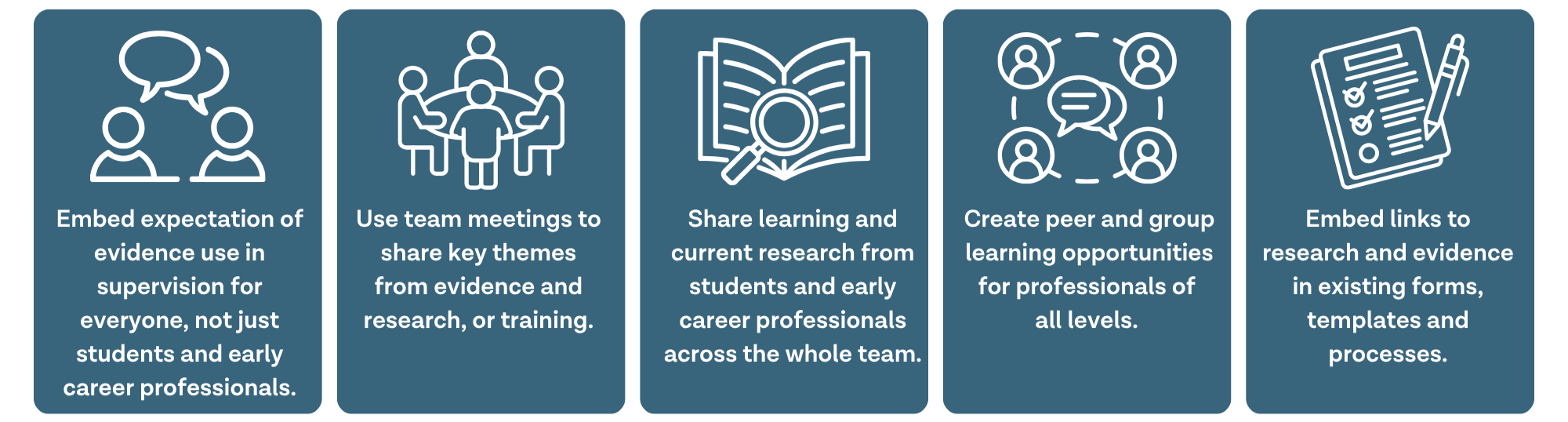
How does the use of evidence impact practice?
Participants gave many examples of resources that had impacted their direct practice:
We heard how a newly qualified practitioner had attended a session that formed part of the project on the emerging use of artificial intelligence (AI) in social work education and practice in England. As a result of sharing an overview of the session with their team, they were asked to share the summary with other social care teams. They have continued to be involved in conversations about the use of AI in practice in social care within their local authority.
A team manager was supporting with a complex case where hoarding was a substantial concern. Research in Practice resources, including a Practice Tool on working with people who self-neglect, alongside specialist advice, guided proportionate decision‑making and informed the legal steps needed.
The findings from these sessions illustrate how small changes within already existing meetings can impact the learning and evidence-based culture.
The following resources can be used to support to evidence-informed practice:
Supporting evidence-informed practice in your organisation
Membership to Research in Practice offers access to learning opportunities, resources, and support for whole organisations.
If your organisation is a member of the Research in Practice network and you would like support with growing engagement with the resources, you can contact the Partner Engagement Team for more information.


What is evidence-informed practice?
Dez Holmes, Director of Research in Practice, explains what evidence-informed practice is, why it’s of particular relevance to the social care sector and what it means for practice and leadership.

Using research - Tools to support evidence-informed practice: Practice Tool (2023)
Developing skills and confidence in research use is key to individual and organisational professional development. These tools will help you identify strengths and gaps that need addressing.

Supporting evidence-informed practice education
Practice educators play a crucial role in social work education. Explore Research in Practice resources to support practice educators and the students they supervise.